
My Favorite Things — Call & Response Workshop
Overview
This workshop is about learning a tune by ear, without panic, and without trying to swallow the whole song at once.
We used My Favorite Things as the vehicle, but the real focus was the process: how to listen, break music into chunks, and reliably put it back together. This is a method you can reuse on any tune you love.
By the end of this workshop, you’ll be able to:
- Warm up with the right scale to match the sound of the tune
- Learn a melody by ear using call and response
- Build phrases using chaining and looping
- Combine chunks into a full section without overload
Audi0
Learning Steps
Quick steps
(the whole process in one glance):
- Warm up with the scale
- Listen to the whole tune
- Listen to the first chunk
- Chain notes to learn the chunk
- Repeat the full chunk a few times
- Loop the chunk (slow → slightly faster)
- Repeat for each new chunk
- Combine chunks as you go
- Use backward chaining to connect bigger sections
- Create exercises from the tune
Full Outline
Warm up with the scale
We began by setting the tonal world of the tune before touching the melody. This makes everything that follows feel more familiar and less random.
The scale for this tune is…
D Aeolian: D0-1-L2-3-A0-L1-L2-3
Play it slowly. Loop it. Use a drone if you like.
This is not about speed. It’s about orientation.
Listen before you play
Before learning notes, we listened.
Here’s a short to get it in your ear right now:
First listen to the entire tune, to hear the shape and emotional arc.
Then to just the first chunk, so the ear has a target.
This step matters more than it feels like it should.
Listening creates a memory you can lean on later when your fingers get confused.
Listening is practice too…
Learn the first chunk by chaining notes
The melody was learned through call and response, one note at a time.
Start with the first note.
Add one more.
Then another.
Here’s how this looks for the first quarter of this tune:
D0
D0-A0
D0-A0-A0
D0-A0-A0-D1
D0-A0-A0-D1-0
D0-A0-A0-D1-0-0
D0-A0-A0-D1-0-0 | G1
D0-A0-A0-D1-0-0 | G1-D0
D0-A0-A0-D1-0-0 | G1-D0-0
D0-A0-A0-D1-0-0 | G1-D0-0-D1
D0-A0-A0-D1-0-0 | G1-D0-0-D1-0
D0-A0-A0-D1-0-0 | G1-D0-0-D1-0-0
Even if you think you already “have it,” do the chaining anyway.
Chaining strengthens memory and reduces slips later.
Once the full chunk is built:
- Play single reps of the whole chunk
- Then loop it
- Start slow
- Speed up only a little
Loop to stabilize the phrase
Looping turns information into music.
We looped short phrases until they felt automatic.
If something fell apart, we slowed down and used less effort.
This is also where good technical habits showed up:
- Lighter finger pressure
- Less gripping
- Cleaner string crossings
If your hand got tired, that was useful feedback, not a failure.
Repeat the process for each chunk
Each new section followed the same pattern:
Listen.
Chain notes.
Loop.
Combine with what you already know.
As new chunks came in, we chained chunks, not just notes.
Small chains became bigger chains.
Eventually, those chains became a full section.
Use backward chaining to connect sections
To put larger sections together, we used backward chaining.
Instead of always starting at the beginning:
- Practice the ending
- Then add what comes before it
- Then connect forward again
This makes transitions stronger and reduces the “I always fall apart here” problem.
Create exercises from the tune
Some tricky spots revealed useful technical exercises, especially around string crossings.
Examples we pulled out:
- G3–D3
- DL2–GL2
- G3–D3–DL2–GL2
We also explored fingering options for C♯:
- Raised third
- Low fourth
Both work. One may feel more stable than the other.
The goal is flexibility, not dogma.
Bring in lyrics if they help
If you know the lyrics, they can act like a memory hook for the melody.
They’re not required.
But for many players, lyrics add another layer of orientation that helps phrases stick.
Use them if they help. Ignore them if they don’t.
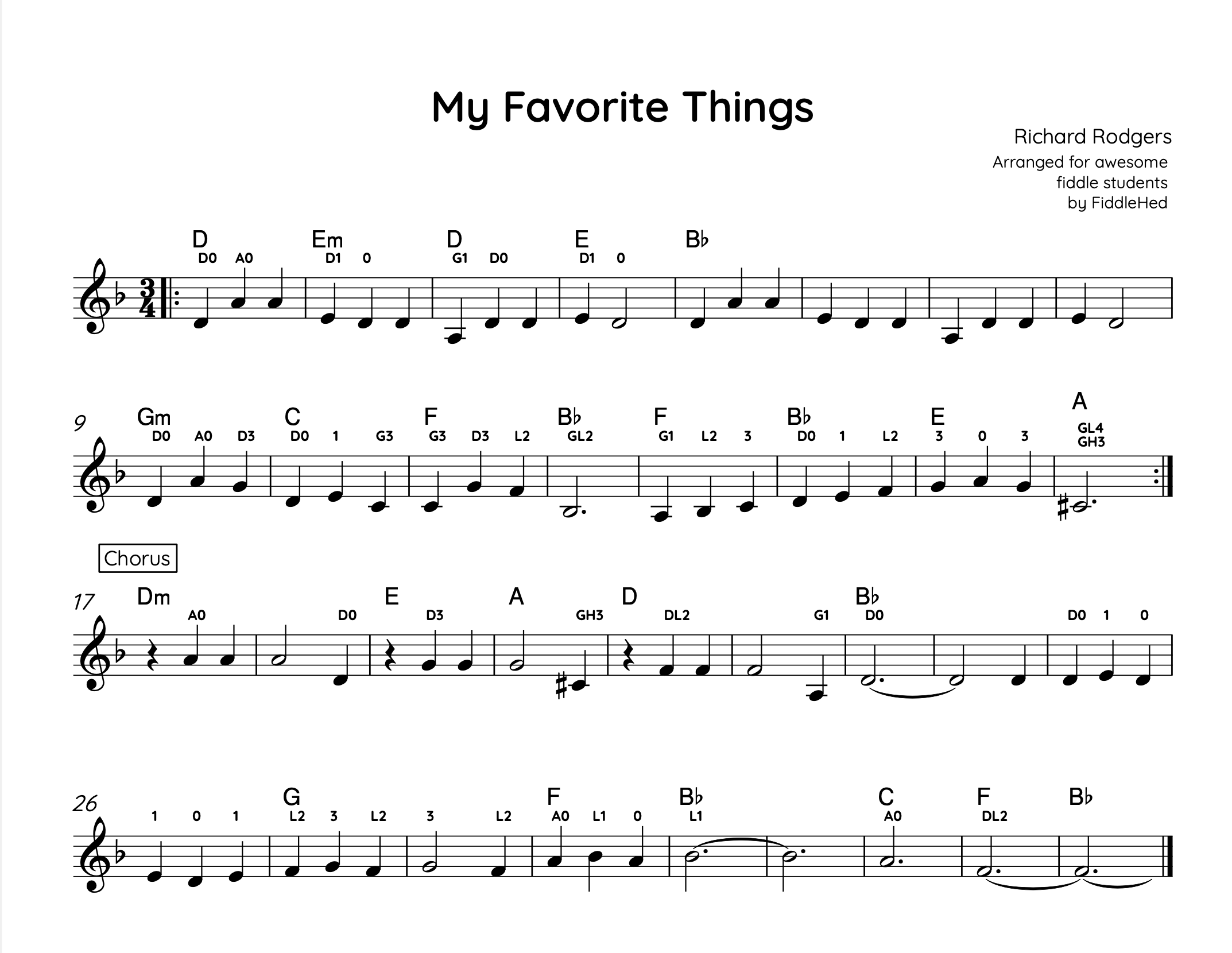
Below you’ll find sheet music.
I strongly recommend trying to learn at least the beginning of the tune through call and response, and then when you get really stuck, let’s look at the sheet music.
Sheet music
Reflect
Take a moment to check in with your experience.
- What part of the tune felt easiest to remember?
- Where did things start to feel fuzzy?
- Did looping or backward chaining help more?
- How did starting with the scale change the learning process?
- What technical habit showed up that you want to keep working on?
Further Learning
Use this same process on another tune you already know well.
Then try it on a tune you don’t know at all.
Mini challenge:
- Day 1: Listen and find the scale
- Day 2: Learn one chunk by ear
- Day 3: Loop it and add one more chunk
Small steps. Same process. Different song.