What the heck is transposition?
Do I need to know calculus to do that? 🤯
Transposition means playing a tune in a different key. It’s one of the most useful skills you can build. If someone at a jam says “let’s do that in A instead of D,” you want to have the tools to make that work — even on the fly.
Start with tunes you’ve already memorized and can play well. But if you’re new to this, try it on a single phrase you just learned. That’s actually the easiest way in.
Two Kinds Of Transposition
Direct transposition means moving to a new key with the exact same fingering. Just shift to a different string. Quick and intuitive.
I teach Amazing Grace in G major. It starts on open D.
D0 | D3-A1-D3 | A1-0 | D3-1 | D0-0
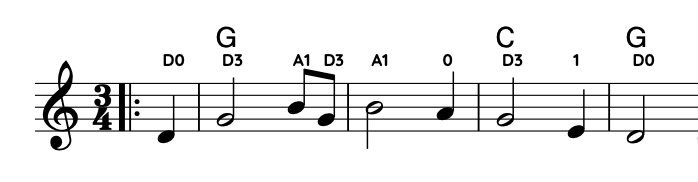
Start on open G with the same fingering and it transposes to C major.
G0 | G3-D1-G3 | D1-0 | G3-1 | G0
Start on open A instead, and you’re in D major.
Indirect transposition means working out a new fingering for the new key. More thought required — but it opens up far more keys.
Start on G3 and the tune moves to F major.
G3 | DL2-A0-L2 | A0-D3 | DL2-0 | G3
But How Did You Figure Out That Fingering?! 😫
Here’s the process for indirect transposition:
- Play the scale for the original key
- Play the tune in the original key
- Find the first note — which scale step is it?
- Play the scale for the target key
- Find that same scale step — that’s your new starting note
- Play the first chunk (one to two bars) in the target key
This also works for direct transposition. In fact, I encourage you try that first.
Don’t worry if this feels abstract right now. It will make sense once you try it with a real tune.
This is an excerpt from Practice Playground, a work in progress. Version 2 drops for FiddleHed subscribers within the next few weeks. 🎻
Why Bother With Transposition? 🙋🏽♀️
Transposing a tune you already know is one of the best ways to memorize it more deeply. You hear it differently. You feel it differently under your fingers. It sticks.
It also helps you play with others. Someone at a session might call Amazing Grace in E-flat because it matches their voice. The more you practice transposition, the better you’ll handle those moments.
Every time you transpose a tune, you’re seeing it from a new angle. You’re developing a fiddler’s intuition — the ability to hear a tune and find it anywhere on the instrument. That’s not just practice. That’s creativity.
The practice is the art.
Further Learning
For subscribers…
Amazing Grace on Fiddle — Easy Beginner Tutorial
Basic tune tutorial plus “Going Deeper” Lesson on transposition, chords and adding variation.
Joy To The World of Transposition!